Systemic Perspective
We’ve been writing about the powers that our cultural values give us, what it might look like to give up some of that power voluntarily, and what new powers we might gain from a change in perspective.
A quick rundown:
- Slowing our adoption of new technologies might boost local communities or protect our water
- Refusing internet delivery might foster local economies and increase local skills
- Only accepting food from people we personally trust might make us healthier and stronger
- If we deprioritized efficiency, we might be in a stronger strategic position for resilience
- Being flexible with our plans instead of expecting stability might help us prevent human-caused climate change
- Driving less can save us money, make our children healthier, and foster economic development (if you’re into that sort of thing)
One reason Michal & I wanted to start this mini-series of newsletters was to highlight how many of our cultural norms are just human thoughts and behavior. These are not laws of nature, and we can change them. Our City Council is about to spend another quarter-billion dollars directing the development and maintenance of our infrastructure, and they can change how they do that. As individuals we behave in certain patterns that we are able to choose to shift in incremental ways.
I want to wrap this series up with a note about individualism. We have a strong cultural value of individualism, from the idea of “property rights” all the way across the ideological spectrum to “respecting people for who they are.” Anyone should be able to do anything they want. You do you.
This gives each of us a lot of power. I love being able to innovate and move quickly. I love not being constrained, and, if I’m honest, I also love the feeling of breaking constraints. It’s great to be able to order whatever you want, get whatever job or education you want, and believe whatever you want. It's frustrating to work with people who see things differently.
But individualism only gives us individual power. Is it any wonder we have an epidemic of loneliness? Why we don’t seem to have the political power to protect our own water, despite the fact that everyone who lives here needs it?
What parts of individualism might we be able to let go of to gain more powers under solidarity?
Celebration of Stories of Community
Working in solidarity is difficult. It takes skill, logistics, time, and a belief that solidarity itself is a valuable outcome. If you want some trees planted, you can get them planted sooner with a shovel than with your neighbors. But at RSFIC, we value growing solidarity over short-sighted priorities like speed or efficiency.
Hundreds of groups of people around Iowa City choose to work in groups instead of alone, and RSFIC regularly holds a few of them up in a place of honor with our friends at FilmScene.
The next celebration is Saturday, May 30th, at 12:30 PM, downtown at the Chauncey. Please come and help us show these folks that we value their contribution to society, and would like to see more people working together like they do. It makes a big impact for a small team to see a hundred folks clapping for them. More details here.
One of the films will be about the Iowa City Repair Cafe. It was started by the unincorporated Transition Town Iowa City, which I think is one of the most interesting and inspiring examples of our budding resilience culture here in town. Now the Repair Cafe is its own separate organization, and Transition Town is regrouping to cause the next small step towards a post-carbon world.
- Mark your calendars for the celebration! Saturday, May 30th, at 12:30 PM
- Preview the Repair Cafe film here.
- If you prefer the more abstract level of transition, come to the next Transition Town event!
Volunteer to help us build solidarity
RSFIC’s main call to action is basically “organize your neighborhood to relocalize power!” but we also need help at the organizational level. We share space with thousands of people for free, and that takes intention, planning, and elbow grease. We create gatherings and make connections which takes expertise and… elbow grease!
In the last week, Denny fixed a baseboard which makes our space more welcoming to people and less welcoming to rodents. Kady helped the Tai Chi Class know how to close up the space and leave it ready for the next folks to use for free. John, Wangui, Michal and myself helped RSFIC stay on track in an advisory board meeting - and a big welcome to Adam, Tamy, and Ryan who went through our volunteer orientation so they’re more ready to help in the future.
Here are some opportunities to help coming up - if you’re already in the system you can sign up at https://portal.rsfic.org/shifts !
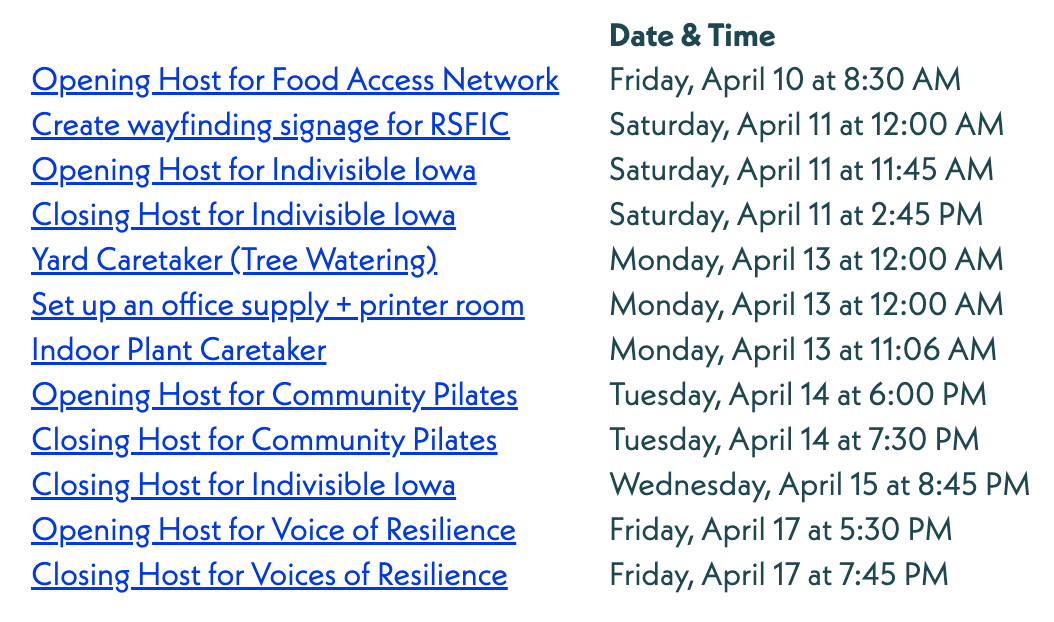
If you’re interested in doing this type of work, there are a few especially easy ways to get involved:
- Next volunteer orientation is Wednesday, May 6th, at 4 PM. Email [email protected] with questions
- We’re having a garden day on Saturday, May 16th, at 9:00 AM to get the yard ready for our super-mysterious launch party!
- Also we’re just hanging out every Wednesday morning at Zoetic Coffee around 9 AM.
Other Solidarity-Building and Power-Relocalizing Events Around The Community
Here’s just a sampling:
- Tuesday, April 14th, 6:30 PM - Rematriating Urban Spaces: Indigenous-Led Resilience Hubs and Land Liberation, hosted by GPAS
- Thursday, April 16th, 6:00 PM - Is No Kings Helpful? Hosted by GPAS
- Saturday, April 18th - Voice of Resilience, hosted by IWNJC
- Consider checking the calendars of the library, PS1, Wright House
See more at our events page.
Denaturalizing Power
There are lots of rules we live by. Some of them are natural laws, like “we need water to live” and “gravity.” We can’t change them. Others are not natural laws, like “you have to build parking spots for cars” or “we subsidize factory construction.”
As we’re going through the world, I think we should remember that the un-natural laws have proven that they are unhealthy for our relationship with the natural ones. When considering changing, we shouldn’t start from the point of view that the way we’ve done things is the way we should keep doing things - that’s not even an option.
Peace,
Riley