Systemic Perspective
A physical object is in "stable equilibrium" if, when you nudge it, other forces naturally occur to push it back into place. For example, a rake hanging from the garage wall is in stable equilibrium because if you push it a little, then gravity torques it back to its starting position - it just swings back. On the other hand, imagine a rake standing upright on the floor, perfectly balanced long-ways up on its handle. That's an unstable position because even a small little nudge will make it so gravity torques the rake farther and farther from its original orientation (aka "falling").
Some configurations of matter just seem to be favored by the universe. These favored patterns seem to be why wild populations of animals and plants naturally stabilize in their environments, why rivers form, and also why galaxies are mostly circular. Nature just sort of gets rid of unstable stuff - piles of rock fall, houses deteriorate, acids neutralize.
We're all watching what's happening with various levels of our legal system right now - lawmakers, judges, and law-enforcement officers are all dealing with some pretty major nudges (and adding their own nudges!). I think some folks are looking at the situation as a rake hanging from its hook, perturbed but fundamentally stable. I think others are looking at it like a rake balancing on its end on the floor - natural forces are accelerating things and the rake is never going to stand back up (if we even want it to).
Wouldn't it be nice to know for sure which one we're looking at?
Upcoming Events
How to rebuild our social fabric and local resilience in a time of chaos
Starting Monday, Jan 26th 6:00pm - 7:30pm (5 sessions total) at the RSFIC Gathering Space
RSFIC co-founder Michal Eynon-Lynch is running another 5-week resilience courses. Folks who participated in the last one started a local foods group and a neighborhood shade-and-food group that are still going almost a year later.
Michal's had experience in many different forms of intentional community, has been the president of several multi-million-dollar companies and non-profits, has a masters in contemplative education and is a master food preserver. This is a pretty cool opportunity to learn more about systemic resilience and positive ways we can build more of it.
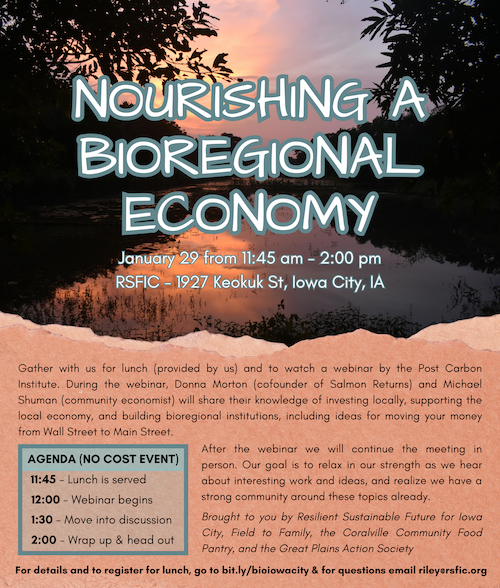
Nourishing a Bioregional Economy Webinar
Thursday, Jan. 29th 11:45am - 2pm at the RSFIC Gathering Space
Gather with us for lunch and to watch a webinar led by the Post Carbon Institute. On the zoom webinar, Donna Morton (cofounder of Salmon Returns) and Michael Shuman (community economist) will share their knowledge of investing locally, supporting the local economy, and building bioregional institutions, including ideas for moving your money from Wall Street to Main Street. Then we'll turn off the zoom and be together in person. We'll be more connected afterwards - our goal is to relax in our strength as we hear about interesting work and ideas, and realize we have a strong community around these topics already. Lunch will be provided, limited seats available!
Volunteering at RSFIC
We've helped groups of neighbors start over 200 projects in their neighborhoods in the last couple years. One of the patterns we've seen is leaders that want to take care of all the little details for their neighbors to make it as easy to participate as they can. A natural and good-spirited idea, but we've slowly realized it's a mistake!
The little details - bringing the drinks, delivering the invitations, sweeping the floor - are also the easiest details. So, they make the easiest ways for other people to get involved! We've seen that when our neighborhood leaders leave these small details for others to do, it's a natural on-ramp for those people to take their own leadership in an easy way.
And then, ha, we realized we were making this mistake ourselves. We were trying to make everything easy for everyone, when really we think people are looking for meaningful ways to contribute (not easiness).
In 2026 we're going to focus on identifying ways for people to contribute to RSFIC's mission in meaningful ways. We've been honored by folks pitching in in the past - from helping us renovate our gathering space to helping us set up our gardens - but we're working on being more intentional about it. We're inspired by the open way that the bike library has created opportunities for hundreds of people to pitch in, and we're seeing that the community they've created is strong and passionate and cool and genuine and powerful, and we're going to try to follow their lead on this.
TL;DR: We've identified a few ways we could really use some help. We're not the best at this, but please respond if you're interested in helping us with:
- Cleaning our shared gathering space, where dozens of groups and thousands of people have gathered in power for free
- Opening & closing the space and helping others know how to care for it
- Making our gardens grow (we already have a lot of folks helping us with this but the more the merrier)
Peace,
Riley
Co-founder of RSFIC