Systemic Perspective
Most financial investments made in Iowa City this decade were given to companies that undermine our power. For example, many of our retirement accounts have helped Amazon build warehouses here, and those warehouses make it easier for Amazon to undercut our local businesses. Vape shops are proliferating because we haven't invested in the local businesses we wish would replace them.
But I think things are changing. We're learning that billionaires aren't necessarily geniuses, they might just be anti-social. We're realizing our consumption is an addiction thrust upon us by manipulative advertising. The thing that gives me the most hope is that we're remembering that what really makes us happy and healthy is being connected to other people, and re-learning the skills that build connections!
And we have some real innovators who've been working for a long time to re-create community-strengthening organizations. Field to Family makes it easy to buy stuff from dozens of local food companies, and it's really working - because of Field to Family, Iowans spend about a million dollars a year locally that they would otherwise have to send out of the state. Backyard Abundance has been teaching folks ways to live more connected to the land since 2006! The Housing Fellowship has been building economically productive and regenerative housing patterns since 1992, serving 13,000 people with affordable housing and demonstrating we can make money doing it.
So we're all waking up, AND we have many mature examples of things we know work here in Iowa City. These are two ingredients of a pretty strong strategic position! This is going to be an exciting time of relocalization and solidarity. And I think if we play our cards right, this could all lead to a low-energy future that also comes with lower stress, less loneliness, and more satisfying purpose for all of us.
RSFIC's Contribution So Far
RSFIC started in 2021 with our longest-running program: local financial investments. We've invested millions of dollars in making accessible space for Wright House, Tamarack Discovery School, FilmScene, MDCIowa, Immigrant Welcome Network, Great Plains Action Society, the Bike Library, community theaters, food coalitions, affordable housing coalitions, and more than 50 other groups. Because this is solidarity, not charity, this makes RSFIC stronger as well as our partners, and today RSFIC has a monthly income of tens of thousands of dollars from these investments. At the same time, our partners are also saving millions of dollars. According to FilmScene, they would not have been able to purchase their ped mall building without the type of local investment we are modeling.
That's exciting because it's inspiring other folks to think about regenerative investments. Johnson County is exploring creating a $2M affordable housing fund based on our FilmScene model. Other private foundations are asking us how to invest locally. Groups of neighbors are pooling their cash to invest in their neighborhood. Individual people are asking if there are ways they can put smaller amounts of money to work locally. The Unitarian Universalist Society created a microloan program with MDCIowa.
Two years ago, RSFIC started our Neighbors to Neighborhood grant program, helping groups of neighbors invest time, skills, and cash in their own neighborhoods. These are much smaller projects - many requiring NO money to execute, just some structure and support. To date, we've helped neighborhood groups start over 200 projects they designed to strengthen their neighborhood.
This is exciting because it's also part of a cultural change. Big Grove started their own neighborhood grant program similar to RSFIC's. Strong neighborhoods are becoming regular parts of strategic plans. We don't claim to have invented the idea of strong neighborhoods, but we're happy to be adding so much momentum to the idea that real economic development starts with diverse groups of powerful people who live in community.
What's Next?
Our vision is an Iowa City where everyone's living in right relationship to nature and has resilient access to water, food, energy, shelter, and community. To make that happen, we need to get to a point where, among other things, we have a regenerative economy - local successes funding local investments which create more local successes, without value leaking out to the global extraction machine.
The really exciting part for me is that many parts of the regenerative cycle are already in place, and have been operating for decades!
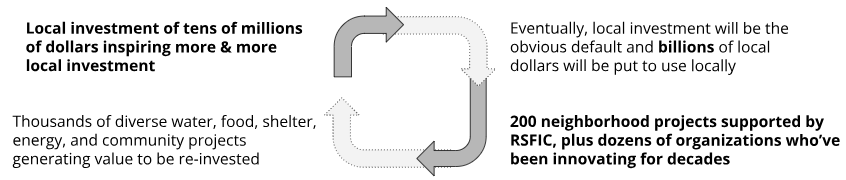
The parts in bold are already happening in Iowa City. We just need to keep shifting our cultural structure to fill in the dotted lines, and we can be free of the extractive engines that keep us busy, isolated, poor, sick, hungry, and anxious!
How's that for a job advertisement?
RSFIC is a core team of six folks today, and we need help filling in the dotted lines. We have an immediate full-time employment opportunity for an Admin Assistant role.This role will be responsible for calendar & time management, communication support, and administrative support - things like coordinating meetings, corresponding with community members, managing filing systems, and doing errands and tasks as they crop up. We pay well and provide health insurance, plus aligning your day-to-day work with a hopeful path for surviving climate collapse and the end of cheap energy. We're looking for folks who can be mission-driven, have strong communication skills, and technically proficient with officey software like google docs / calendar / slides / etc. We'd like to fill the role and get started by February. The full job description & process are attached to this email.
If you're interested, write [email protected] for more information!
If you're not interested, please think of three folks who might be interested and forward this to them :)
Re. Hope & Despair
I was honored to receive some critical feedback about my newsletters from a mentor of mine (thanks Curt!). As I heard him, he was saying that maybe, especially at this tough time of year, my newsletters would depress people to the point of hopelessness. One very bad effect was that I might significantly harm readers. Another less bad but still bad effect was that I might just not get very much done. Like my mentor, I believe positivity is more effective than negativity, and maybe I've sometimes had too much negativity.
A piece of artwork from Tumblebug Press is in the RSFIC office, quoting Wendell Berry, saying:
"The news from the land under our feet is not good, but the most hopeless thing we can do is ignore it or pretend it is not so bad."
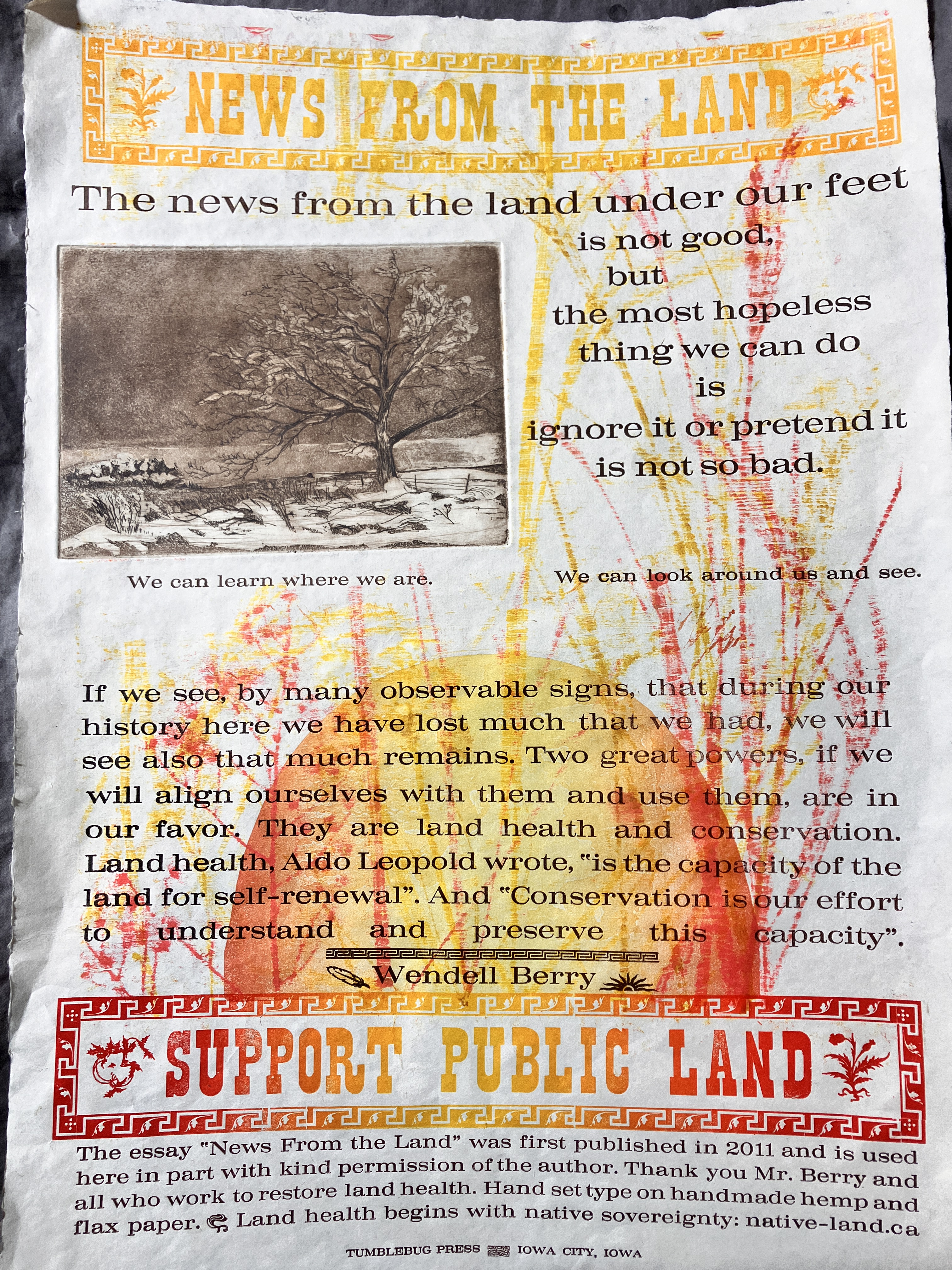
"If we see, by many observable signs, that during our history here we have lost much that we had, we will also see that much remains."
I guess I want to share that I have a fair amount of despair. But I'm also really hopeful for a future with less anxiety, isolation, sickness, hunger, and guilt. All species on Earth will be going through huge changes in the next couple years here, and I expect them to be difficult, but I'm earnestly hopeful they will teach us new and better ways to relate to each other.
Hope is powerful and regenerative
We have so many resources at our fingertips, almost anything we can imagine is possible. The obstacles in our way are as thin as human decisions and just require a bunch of different decisions. Momentum is building, and if I'm reading my Watterson correctly, snowballs gonna snowball. We'll have a resilient, sustainable future, one way or another, and I think it might be great :D
Peace,
Riley
Co-founder of RSFIC